All Together Now!
We can have all of them in one equation:
y = A sin(B(x + C)) + D
- amplitude is A
- period is 2π/B
- phase shift is C (positive is to the left)
- vertical shift is D
And here's how it looks on a graph:
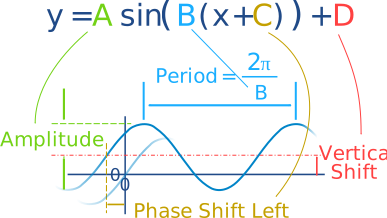
Note that we are using radians here, not degrees, and there are 2π radians in a full rotation.
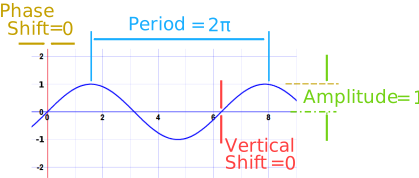
Example: sin(x)
This is the basic unchanged sine formula. A = 1, B = 1, C = 0 and D = 0
So amplitude is 1, period is 2π, there's no phase shift or vertical shift:
Phase shift can be tricky with signs:
- Using y = A sin(B(x + C)) + D, then C > 0 shifts the graph left
- Some books use y = A sin(B(x − h)) + D, where h > 0 means a shift right
These match because C = −h.
Example: 2 sin(4(x − 0.5)) + 3
- amplitude A = 2
- period 2π/B = 2π/4 = π/2
- phase shift = −0.5 (or 0.5 right)
- vertical shift D = 3
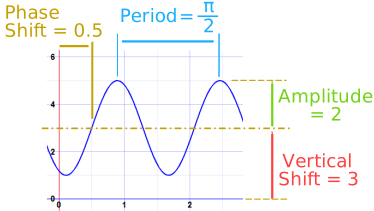
In words:
- the 2 tells us it will be 2 times taller than usual, so Amplitude = 2
- the usual period is 2π, but in our case that's "sped up" (made shorter) by the 4 in 4x, so Period = π/2
- and the −0.5 means it will be shifted to the right by 0.5
- last the +3 tells us the center line is y = +3, so Vertical Shift = 3
Instead of x we can have t (for time) or maybe other variables:
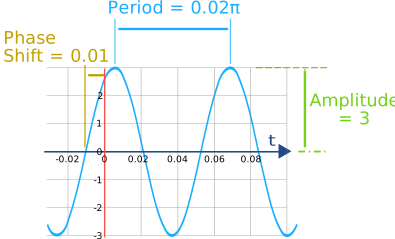
Example: 3 sin(100t + 1)
To see the phase shift, we factor out 100 inside the sine:
3 sin(100t + 1) = 3 sin(100(t + 0.01))
Now we can see:
- amplitude is A = 3
- period is 2π/100 = 0.02 π
- phase shift is C = 0.01 (left)
- vertical shift is D = 0
And we get:
Frequency
Frequency is how often something happens per unit of time (per "1").
Example: Here the cosine function repeats 4 times between 0 and 1:
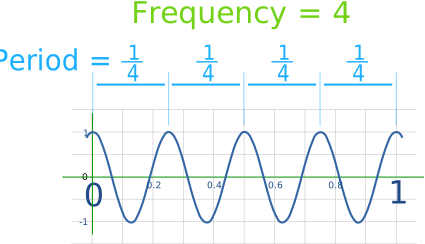
So the Frequency is 4
And the Period is 14
In fact the Period and Frequency are related:
Frequency = 1Period
Period = 1Frequency
Example from before: 3 sin(100(t + 0.01))
The period is 0.02π
So the Frequency is 10.02π = 50π
Some more examples:
| Period | Frequency |
|---|---|
| 110 | 10 |
| 14 | 4 |
| 1 | 1 |
| 5 | 15 |
| 100 | 1100 |
When frequency is per second it is called "Hertz".
Example: 50 Hertz means 50 times per second

The faster it bounces the more it "Hertz"!
Animation
How to Sketch y = A sin(Bx)
Knowing A and B we can sketch a graph by hand:
Work out the Period (P): Calculate P = 2πB. This is the width of one full cycle.
Use the 5-Point Rule:, mark these 5 points over one full period (P):
- Start: (0, 0)
- Peak: (P4, A)
- Middle: (P2, 0)
- Valley: (3P4, −A)
- End: (P, 0)
Connect the dots with a smooth wave!
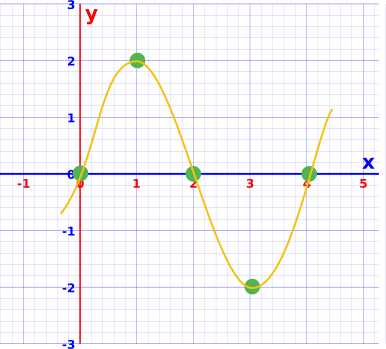
Example: A=2, B=π/2
P = 2πB = 2ππ/2 = 4
Points are: (0, 0), (1, 2), (2, 0), (3, −2), (4, 0)
Mark the points, sketch the wave:
Writing the Function from a Graph
You can be a "math detective" and work backward from a graph to work out its equation.
First work out A and B:
- A: measure the height from the center line to a peak
- B: calculate: B = 2πPeriod
Example: a graph where the peak is at 3 and it repeats every π
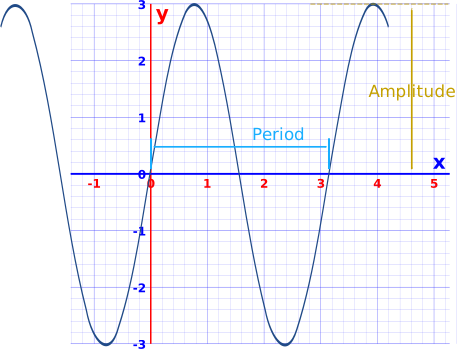
- Amplitude A = 3
- Period P = π, so B = 2ππ = 2
- The equation is: y = 3 sin(2x)