In Polar Form
(example: 3 + 4i)

(distance and angle)
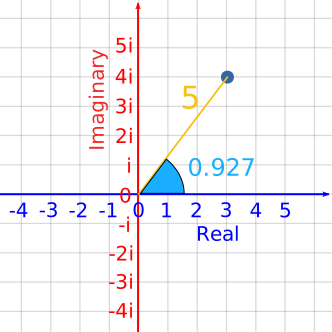
In other words the complex number 3 + 4i can also be shown as distance 5 and angle 0.927 radians.
How do we do the conversions?
From Cartesian to Polar:
- r = √(x2 + y2) = √(32 + 42) = √25 = 5
- θ = tan-1 (y/x) = tan-1 (4/3) = 0.927 (to 3 decimals)
And back again:
- x = r cos( θ ) = 5 × cos( 0.927 ) = 5 × 0.6002... = 3 (at perfect accuracy)
- y = ri sin( θ ) = 5i × sin( 0.927 ) = 5i × 0.7998... = 4i (at perfect accuracy)
In fact, a common way to write a complex number in Polar form is
x + iy = r(cos θ + i sin θ)
And "cos θ + i sin θ" is often shortened to "cis θ", so:
x + iy = r cis θ
cis θ is just shorthand for cos θ + i sin θ
So we can write:
3 + 4i = 5 cis 0.927
De Moivre
In cis notation the de Moivre formula is:
(r cis θ)n = rn cis nθ
Or without cis notation it is:
[ r(cos θ + i sin θ) ]n = rn(cos nθ + i sin nθ)
The key points are that:
- the magnitude becomes rn
- the angle becomes nθ
Example: What is (1+i)6 ?
First convert 1+i to Polar:
- r = √(12 + 12) = √2
- θ = tan-1 (1/1) = π4
In "cis" notation it is now: √2 cis π4
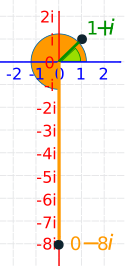
Use the de Moivre formula with an exponent of 6:
(√2 cis π4)6 = (√2)6 cis 6π4
Which simplifies to:
8 cis 3π2
In other words: the magnitude is now 8, and the angle is 3π2 (=270°)
Which is also 0−8i (see diagram)
Note: using Algebra we can come up with the same answer:
- Firstly: (1 + i)2 = 1 + 2i + i2 = 1 + 2i − 1 = 2i
- Then: (1 + i)6 = (2i)3 = 8i3 = −8i
Advanced!
We can prove de Moivre’s Formula using Mathematical Induction:
HARD Example: Proving De Moivre’s Formula
1. Show it is true for n=1
[r(cos θ + i sin θ) ]1 = r1(cos θ + i sin θ) is True
2. Assume it is true for n=k
[ r(cos θ + i sin θ) ]k = rk(cos kθ + i sin kθ) is True (our assumption!)
Now, prove it is true for "k+1"
In other words we want to prove:
[ r(cos θ + i sin θ) ]k+1 = rk+1[ cos(k+1)θ + i sin(k+1)θ ]
The left hand side can be factored into:
[ r(cos θ + i sin θ) ]k r(cos θ + i sin θ)
We can use the assumption above that [ r(cos θ + i sin θ) ]k = rk(cos kθ + i sin kθ), so we get:
rk(cos kθ + i sin kθ) r(cos θ + i sin θ)
Bring rk and r together:
rk+1 (cos kθ + i sin kθ) (cos θ + i sin θ)
Now let us ignore rk+1 for the moment:
(cos kθ + i sin kθ) (cos θ + i sin θ)
cos kθ(cos θ + i sin θ) + i sin kθ(cos θ + i sin θ)
cos kθ cos θ + i cos kθ sin θ + isin kθ cos θ + i2 sin kθ sin θ
cos kθ cos θ + i cos kθ sin θ + isin kθ cos θ − sin kθ sin θ
cos kθ cos θ − sin kθ sin θ + i(cos kθ sin θ + sin kθ cos θ)
Now use the Trigonometric Identities:
sin(A+B) = sin(A)cos(B) + cos(A)sin(B)
cos(A+B) = cos(A)cos(B) − sin(A)sin(B)
With A = kθ and B = θ we get:
cos(kθ+θ) + i sin(kθ+θ)
cos((k+1)θ) + i sin((k+1)θ)
Now bring back the rk+1:
rk+1 [ cos((k+1)θ) + i sin((k+1)θ ]
The left hand side has been turned into the right hand side!
And so:
[ r(cos θ + i sin θ) ]k+1 = rk+1[ cos(k+1)θ + i sin(k+1)θ ]
is True
DONE!
Euler's Formula

We can also create de Moivre's Formula with some help from Leonhard Euler!
Euler's Formula for complex numbers says:
eix = cos x + i sin x
And the exponent laws let us do this:
(eiθ)n = einθ
Now replace eiθ with cos θ + i sin θ, and einθ with cos nθ + i sin nθ:
(cos θ + i sin θ)n = cos nθ + i sin nθ
And including a radius r:
[ r(cos θ + i sin θ) ]n = rn(cos nθ + i sin nθ)
Ta Da! We get de Moivre's formula.