But What Values of n ?
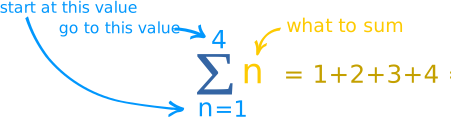
The values are shown below
and above the Sigma:
which is 1, 2, 3 and 4
OK, Let's Go ...
So now we add up 1,2,3 and 4:
Here it is in one diagram:
More Powerful
But Σ can do more powerful things than that!
We can square n each time and sum the result:We can add up the first four terms in the sequence 2n+1:
And we can use other letters, here we use i and sum up i × (i+1), going from 1 to 3:
And we can start and end with any number. Here we go from 3 to 5:
Properties
Partial Sums have some useful properties that can help us do the calculations.
Multiplying by a Constant Property
Say we have something we want to sum up, let's call it ak
ak could be k2, or k(k-7)+2, or ... anything really
And c is some constant value (like 2, or -9.1, and so on), then:
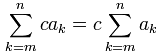
In other words: if every term we are summing is multiplied by a constant, we can "pull" the constant outside the sigma.
Example:
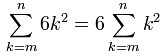
So instead of summing 6k2 we can sum k2 and then multiply the whole result by 6
Adding or Subtracting Property
Here's another useful fact:
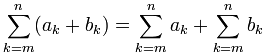
Which means that when two terms are added together, and we want to sum them up, we can actually sum them separately and then add the results.
Example:
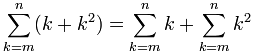
It is going to be easier to do the two sums and then add them at the end.
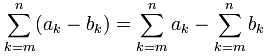
Note this also works for subtraction:
Useful Shortcuts
And here are some useful shortcuts that make the sums a lot easier.
In each case we are trying to sum from 1 to some value n.
Let's use some of those:
Example 1: You sell concrete blocks for landscaping.
A customer says they will buy the entire "pyramid" of blocks you keep out front. The stack is 14 blocks high.
How many blocks are in there?
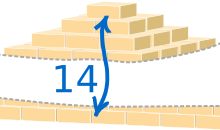
Each layer is a square, so the calculation is:
12 + 22 + 32 + ... + 142
But this can be written much more easily as:

We can use the formula for k2 from above:

That was a lot easier than adding up 12 + 22 + 32 + ... + 142.
And here's a more complicated example:
Example 2: The customer wants a better price.
The customer says the blocks on the outside of the pyramid should be cheaper, as they need cleaning.
You agree to:
- $7 for outer blocks
- and $11 for inner blocks
What's the total cost?
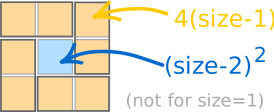
You can calculate how many "inner" and "outer" blocks in any layer (except the first) using
- outer blocks = 4×(size−1)
- inner blocks = (size−2)2
And so the cost per layer is:
- cost (outer blocks) = $7 × 4(size−1)
- cost (inner blocks) = $11 × (size−2)2
So all layers together (except first) will cost:

Now we have the sum, let's try to make the calculations easier!
Using the "Addition Property" from above:

Using the "Multiply by Constant Property" from above:

That's good ... but our shortcut formulas only work when the index starts at 1. Since we are starting at i=2 we need to use index shifting to make the formulas fit.
So let's invent two new variables to reset our starting point to 1:
- j = i−1
- k = i−2
And we have (note we changed 14 to 13 or 12 as needed):
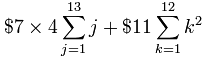
(We also dropped the k=0 case, knowing that 02=0)
And now we can use the shortcuts:

After a little calculation:
$7 × 364 + $11 × 650 = $9,698.00
Oh! And don't forget the top layer (size=1) which is just one block. Maybe you can give them that one for free, you are so generous!
Note: as a check, when we add the "outer" and "inner" blocks, plus the one on top, we get
364 + 650 + 1 = 1015
Which is the same number we got for the "total blocks" before ... yay!