Pythagorean Theorem in 3D

Pythagoras
In 2D
First, let's have a quick refresher in two dimensions:
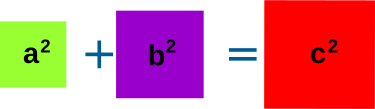
When a triangle has a right angle (90°) ...
... and squares are made on each of the three sides, ...
... then the biggest square has the exact same area as the other two squares put together!

It is called the Pythagorean Theorem and can be written in one short equation:
a2 + b2 = c2
Note:
- c is the longest side of the triangle
- a and b are the other two sides
And when we want to know the distance "c" we take the square root:
c2 = a2 + b2
c = √(a2 + b2)
You can read more about it at Pythagorean Theorem, but here we see how it can be extended into 3 Dimensions.
In 3D
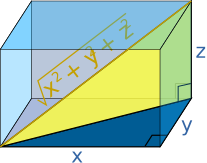
Let's say we want the distance from the bottom-most left front corner to the top-most right back corner of this cuboid:
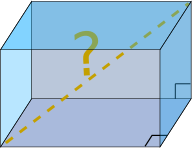
First let's just do the triangle on the bottom.
Pythagoras tells us that c = √(x2 + y2)
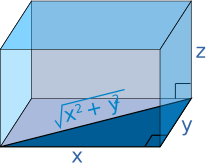
Now we make another triangle with its base along the "√(x2 + y2)" side of the previous triangle, and going up to the far corner:
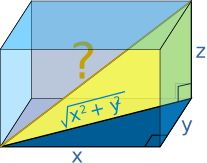
We can use Pythagoras again, but this time the two sides are √(x2 + y2) and z, and we get this formula:
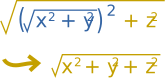
And the final result is:
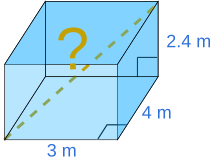
Example: What's the distance from one corner of a room to the opposite corner if the room is 3 meters wide, 4 meters deep, and 2.4 meters high?
- First, find the diagonal along the floor:
√(32 + 42) = √(9 + 16) = √25 = 5 m - Now use that 5m length and the 2.4m height to find the main diagonal:
√(52 + 2.42) = √(25 + 5.76) = √30.76 ≈ 5.546 m
The distance is about 5.546 m.
Or in one go:
√(32 + 42 + 2.42) = √(9 + 16 + 5.76) = √30.76 ≈ 5.546 m
Pattern
It is all part of a pattern that extends onwards:
| Dimensions | Pythagoras | Distance "c" |
|---|---|---|
| 1 (a line) | c2 = x2 | √(x2) = x |
| 2 | c2 = x2 + y2 | √(x2 + y2) |
| 3 | c2 = x2 + y2 + z2 | √(x2 + y2 + z2) |
| ... | ... | ... |
| n | c2 = a12 + a22 + ... + an2 | √(a12 + a22 + ... + an2) |
So we have a formula for calculating distance in any number of dimensions!